
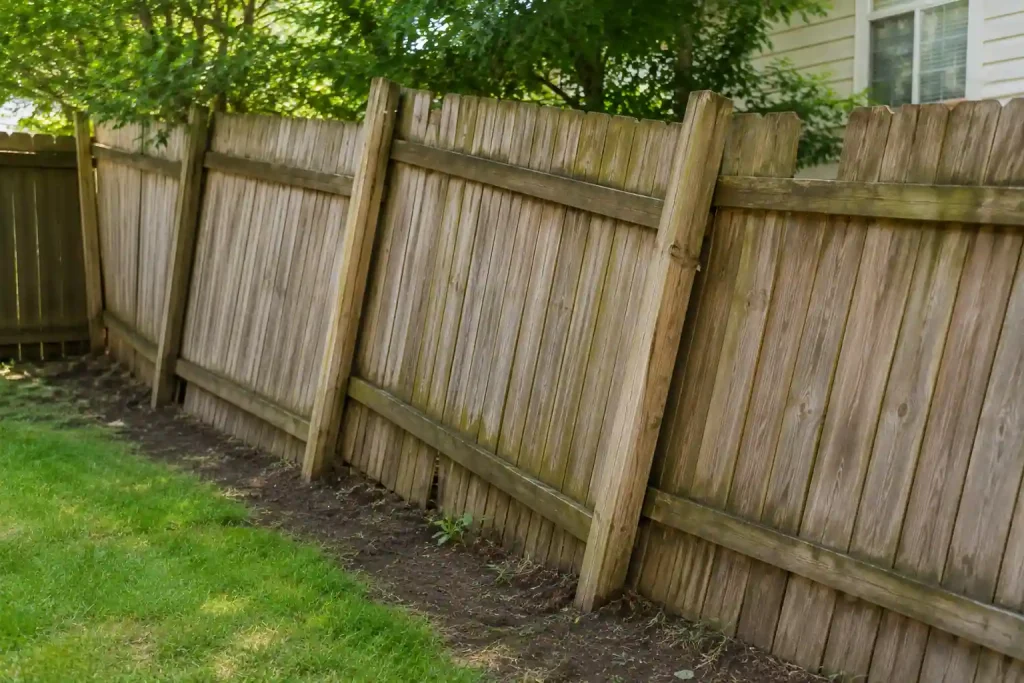
If you’re asking why your fence is leaning, the answer in Roseville almost always traces back to one thing – the clay-rich soil beneath your yard expanding and contracting with the seasons. We repair leaning fences throughout Roseville and understand exactly how local ground conditions affect fence posts differently than they would in a neighborhood with sandier or more stable soil. This guide walks through the specific reasons a leaning fence Roseville, CA homeowner deals with often differ from generic fence advice, and what actually fixes the problem for good.
Roseville Soil Conditions and Why They Matter
Roseville sits on ground with a heavy concentration of expansive clay, sometimes called adobe clay, which behaves very differently from sandy or loamy soil found elsewhere. During Roseville’s wet winter months, this clay absorbs moisture and swells significantly. Once summer arrives and the ground dries out, that same soil shrinks and pulls away from whatever is buried in it, including fence posts.
This expansion and contraction cycle repeats every single year, and each cycle puts a small amount of pressure on the posts holding your fence upright. Over several seasons, that repeated pressure is one of the most common explanations homeowners find when they start researching why their fence is leaning in this specific region, since the same fence built with the same materials in a different soil type would likely hold up longer without issue.
Soil Shifting Fence Posts Out of Position
Soil-shifting fence posts is a direct, physical process rather than a vague explanation. As clay soil swells during wet weather, it grips a post tightly and can actually lift it slightly. When the soil later shrinks during dry months, it releases that grip and leaves a small gap around the post. Wind, foot traffic near the fence line, or the weight of the fence panels themselves can then nudge the post out of true vertical alignment within that loosened gap.
Repeat this cycle enough times and a post that started perfectly plumb gradually develops a visible tilt. This is why a fence post leaning problem often appears gradually over a year or two rather than happening suddenly, and why homeowners sometimes don’t notice the shift until the lean becomes obvious from across the yard.
Soil Erosion Around Fence Posts
Soil erosion around fence posts is a related but slightly different issue, and it becomes especially relevant during Roseville’s heavier winter rain events. Water running along a fence line, particularly on sloped yards or areas without proper grading, can gradually wash away the soil supporting a post’s base. Even a well-set post can begin to wobble once enough supporting soil has eroded away from around its footing.
Poor yard drainage tends to make this worse. If water regularly pools near a section of fencing after rain instead of draining away, that section is at a much higher risk of both erosion and the freeze-thaw pressure that comes from saturated clay soil sitting against the post.
Fence Post Leaning From Improper Installation
Not every leaning fence problem in Roseville traces back to soil alone. A fence post leaning issue can also start with how deep and how securely the post was originally set. In clay soil regions specifically, posts need to be set well below the zone where seasonal soil movement is strongest, and secured with a properly formed concrete footing rather than loose backfill alone.
A post set too shallow, or one surrounded by soil packed back in without a proper footing, has far less resistance against the natural push and pull of expansive clay. This type of leaning fence repair in Roseville often requires resetting the post at a greater depth with a footing built specifically for local soil conditions, rather than simply straightening the existing post and hoping the same shallow footing holds up better the second time.
Related Topic: Do You Need a Permit for Fence Repair in Roseville
When Fence Post Replacement Becomes Necessary
Not every lean can be corrected by simply resetting a post back into place. Fence post replacement becomes the better option once a post has rotted at the base, cracked internally, or become so loosened by repeated soil movement that the surrounding wood or concrete no longer provides a stable anchor point.
Wood posts in particular are vulnerable at the exact point where they meet the soil, since that transition zone holds moisture longer than the wood above or below it. Once decay sets in at that contact point, resetting the post rarely solves the underlying weakness, and full replacement with a properly sized footing is the more lasting solution.
How to Tell Which Cause Applies to Your Fence
A few simple checks help narrow down which of these issues is affecting your specific fence line. Posts that lean more noticeably after a wet winter and seem to straighten slightly during dry summer months point toward the clay soil expansion and contraction cycle common throughout Roseville. Posts that wobble freely when you push on them, with visible gaps or loose soil around the base, suggest erosion or a footing that never fully set.
A post that feels solid at the surface but shows soft, darkened wood at the point where it enters the ground is showing signs of rot rather than a soil-related lean. Identifying which of these patterns matches your fence is the first real step toward choosing the right repair rather than guessing at a fix that may not address the actual cause.
Fence Repair Roseville CA Homeowners Can Rely On
Understanding the cause behind a leaning fence matters because the right fix depends entirely on it. A fence repair Roseville, CA approach built around local clay soil accounts for proper post depth, correctly formed footings, and drainage improvements where needed, rather than applying a generic fix that may only hold for another season before the same lean returns.
Our team evaluates each leaning fence individually, checking post depth, soil condition, drainage patterns, and the physical condition of the wood or metal itself before recommending a repair. This approach means the fix addresses the actual reason your fence started leaning in the first place, rather than only treating the visible symptom.
Related Topic: Repair or Replace Fence?
Frequently Asked Questions
Why is my fence leaning even though it was installed recently?
Even newer fences can lean in Roseville if posts were not set deep enough for local clay soil or if the footing was not properly formed. Expansive clay puts pressure on shallow or improperly anchored posts within the first year or two.
Does Roseville’s soil really affect fence stability that much?
Yes, Roseville’s clay-rich soil expands significantly when wet and contracts when dry, creating a repeated cycle of pressure on fence posts that is more pronounced here than in areas with sandier or more stable soil.
Can a leaning fence post be fixed without full replacement?
Many leaning posts can be reset and secured with a proper footing rather than replaced, as long as the post itself has not rotted or cracked. A physical inspection determines which approach fits your specific situation.
How deep should fence posts be set in Roseville soil?
Posts in expansive clay soil generally need to be set deeper than standard recommendations suggest, well below the zone most affected by seasonal soil movement, and secured with a properly formed concrete footing.
What is the first sign that soil erosion is affecting my fence?
Visible gaps or loose soil around the base of a post, along with noticeable wobbling when the post is pushed, are early signs that erosion has compromised the post’s support.
Schedule Your Fence Repair in Roseville Today
A leaning fence rarely fixes itself, and the underlying cause in Roseville almost always ties back to how local clay soil interacts with post depth, drainage, and installation quality. Our team provides thorough inspections and lasting leaning fence repair that Roseville homeowners can count on, built around the specific soil conditions found throughout the area. Contact us today to schedule your fence assessment.
2 Responses