
Redwood generally holds up better than cedar in Northern California because of its higher density, natural tannin content, and resistance to the region’s damp, coastal climate, though cedar remains a strong and reliable choice for many outdoor projects. If you are comparing cedar vs redwood for a deck, fence, or siding project, our team serves homeowners across Northern California and works with both species daily, so this guide breaks down exactly how each wood performs where you live.
Quick Answer for Northern California Homeowners
When people ask cedar vs redwood, which holds up better in Northern California, the short answer comes down to density and natural oil content. Coastal Redwood tends to outperform Western Red Cedar in long-term durability, while cedar offers a lighter, more budget-friendly option with excellent workability. Both species thrive in the region’s climate since they are native to it, and both remain popular for good reason.
Janka Hardness Rating – Measuring Real-World Strength
The Janka hardness rating measures how much force a wood species can withstand before denting or wearing down, and it gives homeowners a clear, number-based way to compare cedar vs. redwood. Coastal Redwood typically scores higher on this scale than Western Red Cedar, which translates to a surface that handles foot traffic, furniture, and everyday wear with more resilience. Cedar still performs admirably for lower traffic areas like siding, trim, and accent fencing where hardness matters less than workability and finish.
Rot and Insect Resistance: A Built-In Advantage
Rot and insect resistance is where both species genuinely shine, and it is a major reason contractors across Northern California favor them over standard framing lumber. Western Red Cedar and Coastal Redwood each contain natural compounds that discourage termites, carpenter ants, and fungal decay, allowing structures to remain sound for decades with routine care. This built-in protection is part of what makes both woods a smart long-term investment for decks, fences, and outdoor structures exposed to soil contact and moisture.
Natural Tannins and Oils – The Secret Behind Their Longevity
The natural tannins and oils found in redwood and cedar act as a built-in preservative system. Redwood carries a particularly high tannin content, which supports its reputation for handling humidity, coastal fog, and seasonal rain with confidence. Cedar’s aromatic oils serve a similar purpose, giving the wood a pleasant scent while helping it resist decay. These compounds are also responsible for the rich, warm tones both woods display when left unfinished.
Weather Resistance in a Coastal, Foggy Climate
Weather resistance becomes especially important in a region defined by coastal fog, winter rain, and warm dry summers. Redwood’s density and tannin content allow it to manage moisture swings gracefully, expanding and contracting less than many alternative species. Cedar responds well too, particularly in areas with consistent humidity, and its lighter weight makes it a favorite for vertical applications like siding where moisture tends to run off quickly. Left untreated, both woods develop an attractive silvery patina over time, a natural sign of aging rather than a sign of weakness.
Related Topic: Why Is My Fence Leaning
Western Red Cedar – Where It Excels
Western Red Cedar is prized for its straight grain, light golden color, and remarkable dimensional stability, meaning it resists warping and cupping even as temperatures shift. Homeowners frequently choose it for pergolas, shingles, fencing, and siding thanks to its balance of affordability and performance. Its lighter weight also makes it easier to work with for DIY projects and custom builds.
Coastal Redwood – Where It Excels
Coastal Redwood, native to the fog belt stretching along Northern California’s coastline, is closely associated with premium decking and architectural-grade projects. Its density, combined with a naturally deep reddish tone, gives it a refined appearance that many homeowners associate with classic California outdoor living. Because it grows locally, sourcing redwood in this region often comes with a smaller environmental footprint compared to shipping cedar from farther away.
FSC Certified Lumber – A Sustainable Choice
FSC-certified lumber ensures that the wood you choose comes from responsibly managed forests, and both cedar and redwood suppliers now offer certified options. Choosing FSC-certified lumber supports long-term forest health while still giving you access to the beauty and performance of either species. This certification has become an increasingly important consideration for homeowners who want their outdoor project to reflect thoughtful, sustainable sourcing.
Grain Pattern and Texture – The Visual Difference
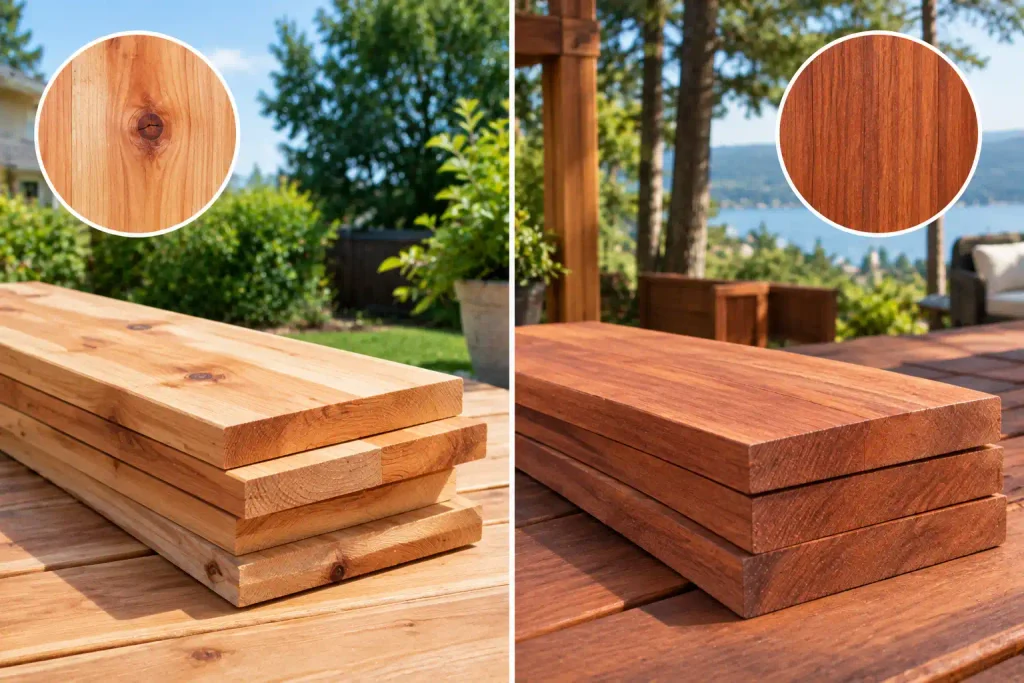
Grain pattern and texture set these two woods apart at a glance. Redwood typically shows a straighter, more uniform grain with fewer knots, creating a smooth, consistent surface that many designers favor for statement decks. Cedar’s grain runs a bit more varied, ranging from tight and linear to gently wavy, giving it a relaxed, textured character that suits rustic and craftsman style homes equally well.
Decking, Siding, and Fencing Applications
Understanding decking, siding, and fencing applications helps match the right wood to the right project.
Decking: Redwood’s hardness and Janka rating make it a strong candidate for high-traffic decks, while cedar remains a comfortable, cost-effective option for smaller or secondary deck spaces.
Siding: Cedar’s light weight and dimensional stability make it a favorite for exterior cladding, shingles, and shakes.
Fencing: Both species perform beautifully here, with cedar often chosen for its value and redwood chosen for its strength and locally sourced appeal.
Related Topic: What to Do After Storm Damage to Your Fence
Northern California Climate – Why Location Matters
Northern California climate plays a defining role in how these woods age. Coastal fog, marine layer humidity, and mild winters create ideal growing conditions for redwood, which is part of why it performs so naturally well here. Inland areas with hotter, drier summers still support both species, though homeowners in these zones often appreciate cedar’s resistance to cracking under intense sun exposure. Wherever you are located in the region, choosing a locally suited species gives your project a genuine performance advantage.
Frequently Asked Questions
Is redwood really stronger than cedar?
Yes, redwood generally scores higher on the Janka hardness scale, making it more resistant to denting and wear over time.
Does cedar last as long as redwood in Northern California?
Cedar offers excellent longevity, especially with routine sealing, though redwood’s density typically gives it an edge in high-moisture, high-traffic environments.
Which wood is better for a foggy coastal property?
Redwood tends to perform exceptionally well in coastal fog belts since it is native to that exact climate.
Is FSC-certified cedar or redwood available locally?
Yes, many Northern California suppliers offer FSC-certified options for both species, supporting sustainable building practices.
Can cedar and redwood be combined in one project?
Absolutely, many homeowners pair redwood decking with cedar siding or fencing to balance strength, cost, and visual variety.
Final Thoughts
Choosing between cedar vs redwood ultimately comes down to your project type, budget, and the specific microclimate of your property within Northern California. Redwood brings superior hardness and a refined, locally grown character, while cedar delivers excellent value, workability, and timeless texture. At Fence Repair Company, our team is happy to walk you through samples, pricing, and application-specific recommendations so your outdoor space performs beautifully for years to come. Contact us now for a free estimate.
One Response